


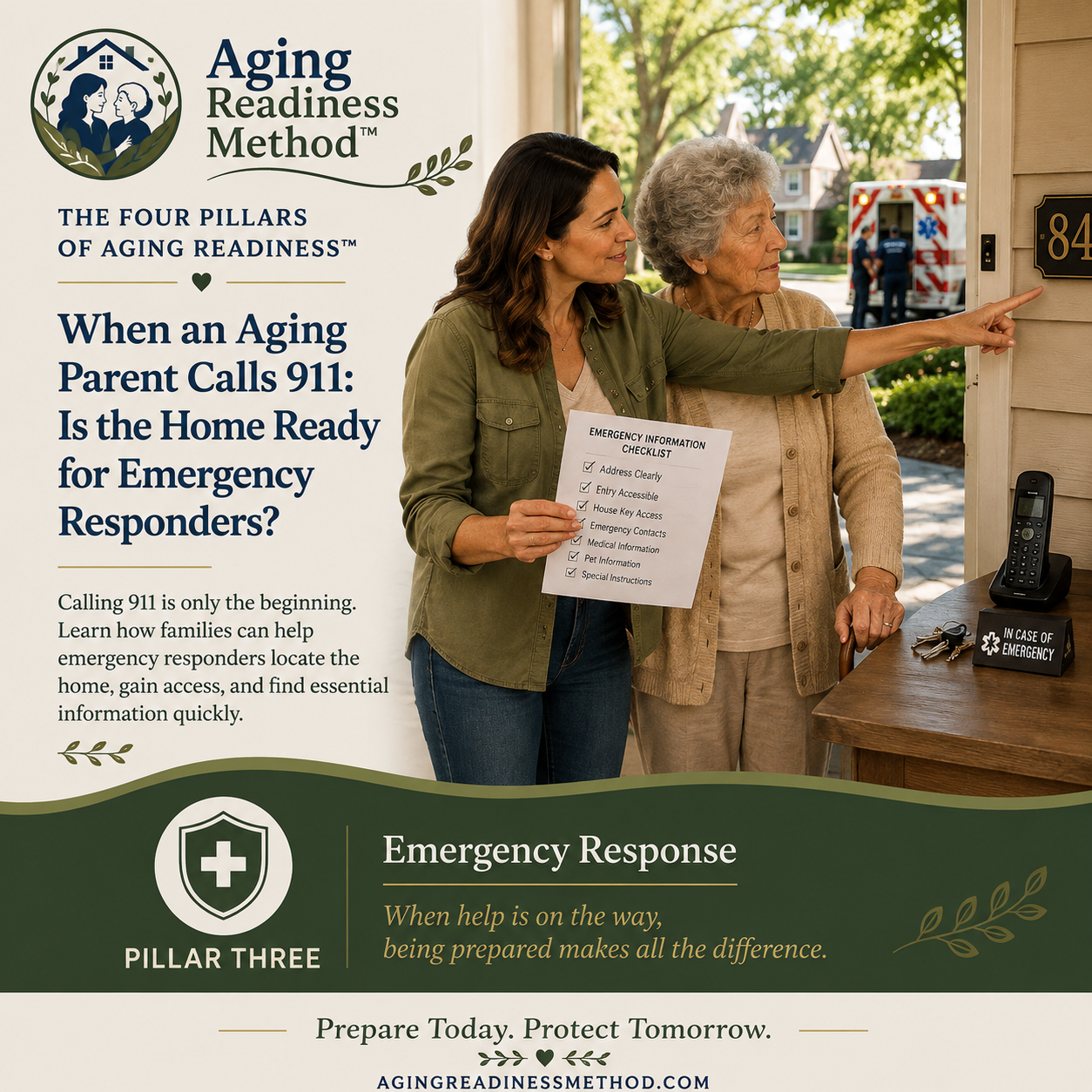
When an Aging Parent Calls 911: Is the Home Ready for Emergency Responders?
Calling 911 is only the beginning. Learn how families can help emergency responders locate the home, gain access, find essential information and assist an aging parent more quickly.
Pillar Three • Emergency Response • 7 min read

Imagine Dad wakes during the night with severe chest pain.
He calls 911.
Help is on the way.
But now consider what happens next.
Can emergency responders easily identify the house from the street?
Is the porch light on?
Is the front door locked?
Can Dad physically reach the door?
Does he have a dog that becomes protective when strangers enter?
Can responders quickly determine which medications he takes?
Does anyone know whom to call after he’s transported?
Calling for help is obviously the most important first step in an emergency.
But families can also prepare the home so that once help has been requested, responders encounter fewer unnecessary obstacles.
That’s a different kind of emergency planning.
Instead of asking only:
“Who should Mom call?”
ask:
“What happens after she calls?”
That question can reveal several simple things your family can prepare now.
1. Start With the Address
This seems almost too basic to mention.
But in an emergency, basic information matters.
Make sure your parent knows their complete home address.
That includes:
- Street number
- Street name
- Apartment or unit number, when applicable
- Community or building name if it helps identify the location
For someone who lives alone or who may become confused under stress, consider keeping the address clearly written near a frequently used phone or another appropriate location.
If your parent uses a mobile phone, don’t assume the device eliminates the need to know the address.
The simplest preparation is still useful:
Know where you are.
2. Look at the House From the Street
One evening, drive or walk past your parent’s home as though you’ve never been there before.
Can you immediately identify the house number?
Look at it:
During daylight.
After dark.
From both directions.
From the street.
From the driveway.
House numbers can become surprisingly difficult to see because of:
Faded paint.
Poor contrast.
Shrubs.
Decorations.
Distance from the road.
Inadequate lighting.
Numbers that are too small.
If the address is difficult for you to locate when you’re calmly looking for it, consider whether it could be improved for someone trying to find the home quickly.
Local requirements for address markings can vary, so follow applicable community or emergency-service guidance.
3. Consider the Front Door
Now imagine emergency responders have arrived.
Can they get inside?
If Mom is able to answer the door, there may be no problem.
But what if she fell in the bedroom?
What if Dad can’t safely walk to the entrance?
What if the person calling 911 becomes unconscious?
Families should think ahead about appropriate emergency access.
Depending on the home and local practices, options might include an authorized family member or neighbor with a key, an appropriate secured key-access solution, building management, or another arrangement.
The right solution will vary.
The important thing is to ask:
“If Mom couldn’t open the door herself, what would happen?”
Don’t hide an unsecured spare key in an obvious location simply for convenience.
Emergency access should still be thoughtful about home security.
4. Think About Apartments and Gated Communities
Emergency access can become more complicated when the front door isn’t the first barrier.
Your parent may live in:
An apartment building.
A condominium.
A gated neighborhood.
A senior community.
A building with controlled entry.
A property with a locked exterior gate.
Consider the entire path from the street to your parent.
Does the community have an established emergency-access procedure?
Is there a building number that can be difficult to identify?
Would responders need an elevator?
Is the unit number clearly displayed?
If you aren’t sure how emergency access works, ask the property manager, homeowners association or appropriate local resource.
Don’t wait for an emergency to discover the procedure.
5. Make Essential Medical Information Findable
Emergency responders may need information about your parent.
Depending on the circumstances, useful information may include:
- Current medications
- Medication allergies
- Significant medical conditions
- Emergency contacts
- Physician information
- Relevant healthcare information
The family doesn’t need to turn the refrigerator into a medical chart.
But important information should be current and findable.
If your community or local emergency services recommend a particular medical-information program, format or location, consider following that guidance.
Otherwise, establish a simple family system and make sure the appropriate people know about it.
The most detailed medication list in the world isn’t useful if nobody can find it.
6. Keep the Medication List Current
A medication list deserves special attention.
Write down enough information to accurately identify the medications your parent currently takes, according to the guidance of their healthcare professionals.
Then date the list.
That last step matters.
A responder or family member who finds a medication list should be able to tell whether it was updated recently or whether it might be three years old.
Consider reviewing the list whenever:
A medication is added.
A medication is discontinued.
A dosage changes.
A significant medical event occurs.
The family doesn’t need to become the medication expert.
It needs to help make accurate information available to the professionals who are.
7. Make Sure Emergency Contacts Are Actually Reachable
An emergency contact list is only useful if the information is current.
Check:
Who should be called first?
Is the phone number correct?
Is there a backup?
Does the person answer calls from unfamiliar numbers?
That final question is increasingly important.
Many people automatically ignore unknown callers.
If you’re designated as an emergency contact for an aging parent, understand that an important call may not arrive from Mom’s phone.
It could come from:
A hospital.
Emergency medical services.
A police department.
A neighbor.
A healthcare provider.
Or another unfamiliar number.
You don’t need to answer every suspicious call without caution.
But designated family contacts should recognize that emergency communication may originate somewhere unexpected.
8. Think About the Phone Before It’s Needed
Where does Mom normally keep her phone?
On the kitchen counter?
In her purse?
Beside her chair?
Charging in another room?
Now ask:
Could she reach it after a fall?
A mobile phone that’s always left in the kitchen isn’t much help if someone falls in the bedroom.
Encourage habits that make communication realistically available.
For some families, that might mean carrying a mobile phone around the home.
For others, it could mean strategically located phones, compatible smart-home communication tools, or an appropriate personal emergency-response system.
Technology is useful only if it’s accessible when needed.
9. Evaluate Medical-Alert Systems Based on the Person
A medical-alert device can provide another way to request help, particularly for someone who lives alone.
Options may include wearable buttons, watches, pendants, home-based systems, fall-detection features and mobile systems.
But don’t choose technology simply because it exists.
Ask:
Will Mom actually wear it?
Does it work where she spends time?
Does she understand how to activate it?
What happens when it is activated?
Does it depend on cellular service, Wi-Fi or another connection?
How is it charged?
Who receives alerts?
Are there ongoing fees?
A device sitting on the dresser because Mom doesn’t like wearing it doesn’t provide the protection the family thinks it does.
Choose tools around the person—not the other way around.
10. Don’t Forget Hearing, Vision and Communication Needs
An emergency can make ordinary communication harder.
Does Dad normally wear hearing aids?
Does Mom need glasses to read?
Does your parent have difficulty speaking?
Is English not their preferred language?
Does cognitive impairment affect communication?
Think about what responders may need to know in order to communicate effectively.
For example, if Dad depends heavily on hearing aids, make sure the family understands where they are normally kept and how they’re maintained.
If your parent has particular communication needs, ask appropriate healthcare professionals or local emergency resources about reasonable ways to prepare.
11. Make a Plan for Pets When Responders Enter
A normally friendly dog may react very differently when unfamiliar people rush into the home carrying equipment.
Ask:
How does the pet respond to strangers?
Could it block the entrance?
Does it tend to run outside when the door opens?
Is there an appropriate way to secure it if circumstances allow?
Your parent shouldn’t delay calling for emergency help because they’re worried about managing the dog first.
Instead, the family should recognize pets as part of the emergency plan.
If your parent is transported, the pet-care plan we discussed in the hospital-readiness article becomes important too.
Someone needs to know:
There’s a pet in the house, and someone needs to take responsibility for it.
12. Clear the Route Responders May Need
Emergency preparedness and home safety overlap here.
Look at the main entrance and pathways through the home.
Are they reasonably clear?
Could emergency personnel move equipment through the entrance?
Is the hallway heavily obstructed?
Would furniture make it unnecessarily difficult to reach the bedroom?
Is there clutter on the stairs?
You don’t need to redesign the house around a hypothetical emergency.
But the same clear pathways that support safer everyday movement can also make the home easier to navigate when help arrives.
That’s one reason the Four Pillars of Aging Readiness™ work together rather than independently.
Home Safety Preparedness supports Emergency Response.
13. Know What Happens if the Parent Is Transported
The ambulance leaves.
Now what?
Which hospital are they going to?
Who follows?
Who notifies the family?
Who secures the house?
Who takes care of the pet?
Who retrieves important items?
Who stays with the other spouse if necessary?
This is where your hospital-ready plan takes over.
Emergency planning shouldn’t consist of isolated checklists.
Each part should connect to the next.
Request help → responders arrive → essential information is available → family is contacted → transportation occurs → hospital plan begins.
That’s a much more complete emergency-response system.
14. Practice Without Creating Fear
You don’t need to stage a dramatic emergency drill.
Simply have a conversation.
Ask Mom:
“If you needed an ambulance tonight, what would you do?”
Then walk through it.
Where is the phone?
What’s the address?
Can responders see the house number?
How would they enter?
Where is the medication information?
Whom should they contact?
What happens to the dog?
You may discover that Mom has excellent answers.
You may also discover one or two small gaps that are easy to fix.
That’s the purpose of the exercise.
Not to frighten anyone.
To make the process more familiar.
Try the Front-Door-to-Parent Test
Here’s a simple ARM readiness exercise.
Walk outside your parent’s home and start at the street.
Imagine emergency responders have just arrived.
Now ask:
Can they identify the correct house?
Can they identify the correct entrance?
Could they gain access if Mom couldn’t reach the door?
Is the pathway reasonably clear?
Are pets likely to complicate entry?
Can essential medical information be found?
Is there a current medication list?
Can an emergency contact be identified?
Does someone know what should happen if Mom is transported?
You’re not trying to simulate everything emergency responders do.
You’re looking for the ordinary household obstacles your family can reasonably address beforehand.
Fix those.
Help Shouldn’t Have to Search for the Plan
Emergency readiness is often described as knowing whom to call.
That’s important.
But ARM takes the idea one step further.
Once the call is made:
Can help find the home?
Can help reach the person?
Can important information be found?
Can the family be contacted?
Does everyone know what happens next?
Those are preparedness questions.
And many of the answers don’t require expensive equipment or complicated planning.
A visible address.
A current medication list.
An appropriate access plan.
A reachable phone.
Updated emergency contacts.
A plan for the dog.
A family that knows what happens after the ambulance leaves.
Small preparations made on an ordinary afternoon can remove unnecessary confusion from an extraordinary day.
You can’t predict when an emergency will happen.
But you can make the home—and the family—more ready when help arrives.
Prepare Today. Protect Tomorrow.