


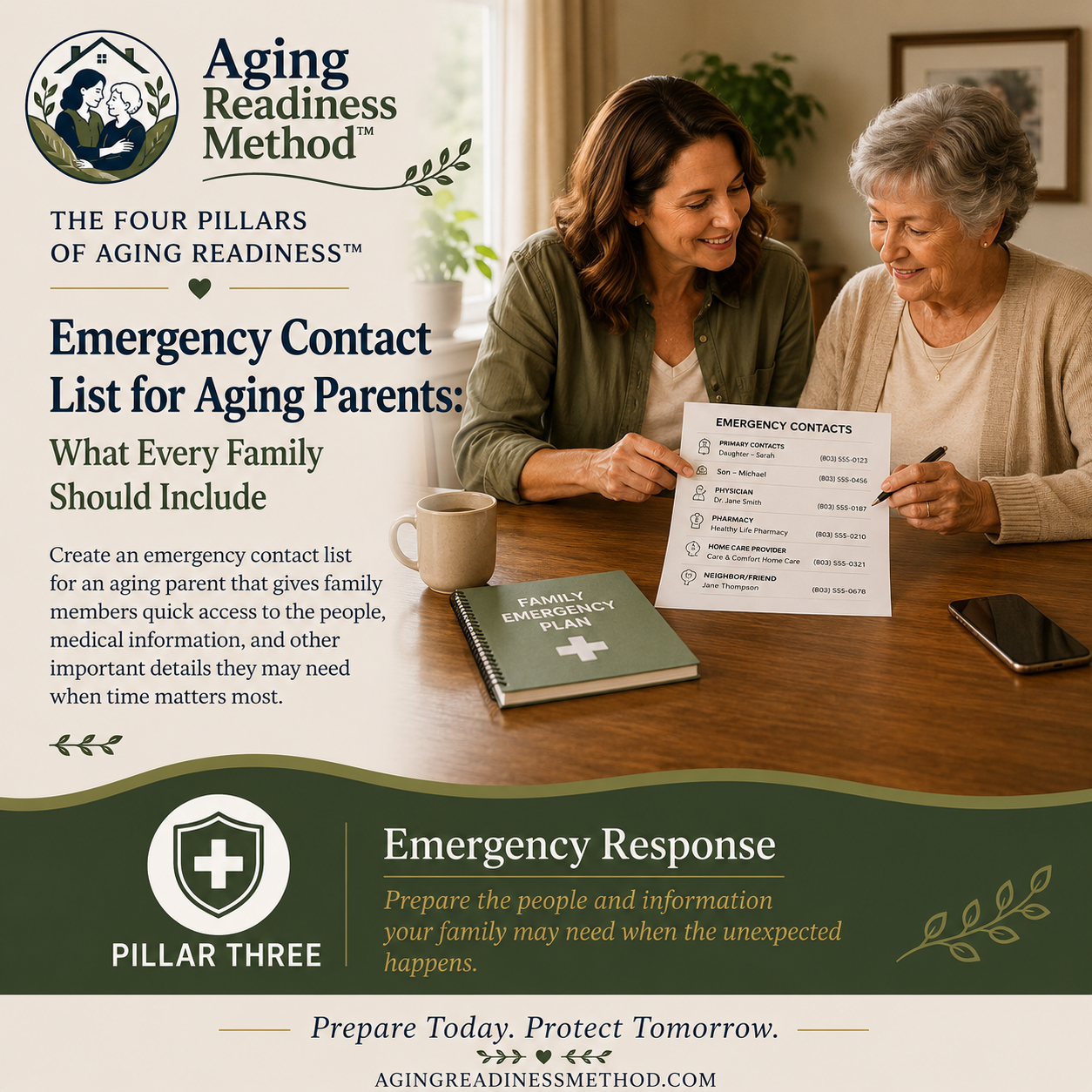
Emergency Contact List for Aging Parents: What Every Family Should Include
Create an emergency contact list for an aging parent that gives family members quick access to the people, medical information and household contacts they may need during an emergency.
Pillar Three • Emergency Response • 7 min read

When an emergency happens, families rarely have time to start gathering information.
A parent falls.
There’s an unexpected trip to the emergency room.
A family member receives a phone call from a neighbor.
A storm knocks out power.
Someone needs to get to the house quickly.
In those moments, even simple questions can suddenly become difficult:
Who should we call first?
What’s Mom’s doctor’s name?
Which hospital does Dad normally use?
Who has a key to the house?
Does anyone nearby know what’s happening?
Most families could eventually find those answers.
Emergency preparedness is about being able to find them when minutes matter and everyone is under stress.
One of the simplest ways to improve that readiness is to create an emergency contact list specifically for your aging parent.
Here’s what to include.
1. Start With Immediate Family Contacts
Begin with the people who should be contacted first if something happens.
For each person, include:
- Full name
- Relationship
- Primary phone number
- Alternate phone number, if appropriate
- Email address
- City or general location
Don’t simply list every relative.
Think about who should actually be called and in what order.
For example:
Primary Family Contact
Daughter — Susan
Mobile: XXX-XXX-XXXX
Secondary Family Contact
Son — Michael
Mobile: XXX-XXX-XXXX
That small amount of organization removes an important question during an emergency:
Who do we call first?
2. Identify Someone Who Lives Nearby
The family member making important decisions may live hundreds of miles away.
That makes a nearby contact especially valuable.
Consider identifying a trusted:
- Neighbor
- Friend
- Relative
- Church member
- Community contact
This person isn’t necessarily responsible for making decisions.
They may simply be someone who can get to the house quickly, check on your parent or provide useful information until family arrives.
Make sure that person knows they’ve been included in the plan.
An emergency contact shouldn’t discover their role for the first time during the emergency.
3. List Primary Medical Contacts
Include the healthcare professionals most likely to be relevant during an unexpected medical situation.
At minimum, consider:
Primary care physician
Include the physician’s name, practice and phone number.
Depending on your parent’s circumstances, the list may also include important specialists.
Avoid turning the emergency contact sheet into a complete medical directory.
The objective is quick access to the people most likely to matter.
4. Include Preferred Hospital Information
If your parent normally receives care through a particular hospital or health system, record that information.
Include:
- Hospital name
- General location
- Relevant health system
This doesn’t mean emergency responders will always transport someone to that hospital. Medical circumstances and local emergency procedures may determine where someone receives care.
But knowing where your parent’s medical records and physicians are generally located can still help the family understand their existing healthcare network.
5. Record Important Pharmacy Information
Medication questions frequently arise during medical emergencies.
Include:
- Pharmacy name
- Location
- Phone number
If prescriptions are filled through more than one pharmacy, note that as well.
The emergency list itself does not need to contain every detail about every prescription if your family maintains a separate current medication list.
Instead, your emergency information should tell someone:
Where can we find the current medication information?
6. Identify Insurance Information
Your contact sheet can identify the relevant insurance coverage and where the actual cards or policy information are kept.
For example:
Health Insurance:
Card located in wallet; copy in medical folder.
Supplemental Coverage:
Information stored in medical records folder.
The emergency list doesn’t need to become a repository for every policy number or sensitive identifier.
Remember the principle we established with important documents:
Sometimes knowing where information is located is more useful than duplicating all of it.
7. Identify Healthcare Decision-Makers
If your parent has designated someone to make healthcare decisions under appropriate legal documents, that person should be clearly identified.
Include:
- Name
- Relationship
- Phone number
- Where the relevant document can be found
Do not assume everyone in the family knows who has been designated.
This is particularly important when several adult children are involved.
The middle of a medical emergency is a terrible time for siblings to discover that they have different assumptions about who is responsible for what.
8. Identify Other Important Legal Contacts
Depending on your parent’s planning, the emergency list may also identify:
- Attorney
- Financial power-of-attorney contact
- Executor or trustee, where relevant
- Other designated representatives
Not all of these people need to be contacted during every emergency.
The point is to create a road map so the family knows who exists and how to reach them if circumstances require it.
9. Don’t Forget the Home
Emergency planning isn’t limited to medical emergencies.
Suppose your parent is unexpectedly hospitalized for a week.
Someone may need to:
Feed a pet.
Get into the house.
Turn off a leaking water line.
Meet a repair technician.
Retrieve clothing or medications.
Check the mail.
Secure the property.
Your emergency contact list should therefore include relevant household contacts.
10. Identify Who Can Access the Home
Ask a simple question:
If Mom couldn’t open the door, who could get inside?
That might be:
- An adult child
- A trusted neighbor
- Another relative
- A property manager
- Someone else designated by your parent
If a lockbox, smart lock or other access method is used, make sure the appropriate trusted people understand how it works.
Avoid placing sensitive access codes or security information on a document that might be widely distributed.
Instead, identify who has authorized access.
11. Include Pet Information
Pets can easily be forgotten during emergency planning.
If a parent is transported to the hospital unexpectedly, someone may need to care for a dog, cat or other animal.
Include:
- Pet’s name and type
- Primary caregiver if the parent is unavailable
- Veterinarian
- Veterinary phone number
- Location of food or necessary supplies
If a pet requires medication or special care, make sure the designated caregiver knows where those instructions are kept.
This is a small planning step that can remove a major source of worry for an aging parent during an already stressful situation.
12. Add Important Household Services
You don’t need every company your parent has ever hired.
Focus on contacts that might matter during an urgent household problem.
Depending on the home, these might include:
- Electric utility
- Gas or propane provider
- Water utility
- HVAC service
- Plumber
- Electrician
- Home security provider
- Property manager or homeowners association
For many families, these contacts can be kept in a separate household section rather than on the primary one-page emergency sheet.
The key is knowing where to find them.
13. Include an Out-of-Area Contact
During a regional emergency—such as a hurricane, winter storm or widespread power outage—local family members may all be dealing with the same disruption.
An out-of-area relative or trusted friend can sometimes serve as a central communication point.
Family members can check in with that person if local communications become difficult.
This is particularly useful for families spread across several cities or states.
14. Decide Where the Emergency List Should Be Kept
Creating the list is only half the job.
People need to be able to find it.
Consider keeping an appropriate copy:
- With the aging parent
- With the primary family contact
- In the family’s emergency information folder
- In another agreed-upon accessible location
A digital copy may also be useful for trusted family members.
Be thoughtful about what sensitive information is included before storing or sharing it electronically.
15. Keep It Current
An outdated emergency contact list can create its own problems.
People change phone numbers.
Doctors retire.
Neighbors move.
Pharmacies close.
Family responsibilities change.
Review the list periodically and whenever there’s a significant change.
A simple date at the bottom can help:
Last reviewed: __________
That tells the person using it whether the information is likely to be current.
Build the List Before You Need the List
You don’t need an elaborate emergency binder to begin.
Start with one page.
Write down:
Primary family contact
Secondary family contact
Nearby contact
Primary physician
Pharmacy
Preferred healthcare system
Healthcare decision-maker
Home-access contact
Pet-care contact
Then identify where the family’s more detailed medical, legal and household information is stored.
You’ve now created something remarkably valuable:
a starting point.
Test Your Emergency Contact List
Once the list is finished, don’t simply file it away.
Try a quick family exercise.
Imagine it’s 10:30 at night and your parent has been taken to the emergency room.
Can you determine within a few minutes:
Who needs to know?
Who can get to the house?
Who is authorized to help with healthcare decisions?
Where medication and insurance information can be found?
Who will take care of the pet?
If the answer is yes, your family is more prepared than it was before.
If something is missing, you’ve discovered the gap while there is still time to fix it.
That’s exactly what preparedness is supposed to accomplish.
Emergency Readiness Is More Than a Phone List
An emergency contact list won’t answer every question your family may face.
It won’t replace a complete emergency plan.
But it creates something families desperately need when an unexpected event occurs:
clarity about what to do first.
And once that first layer is in place, you can build the rest of the family’s emergency plan around it.
Because during an emergency, the best information isn’t necessarily the information you have somewhere.
It’s the information you can find and use when you need it.
Prepare Today. Protect Tomorrow.