


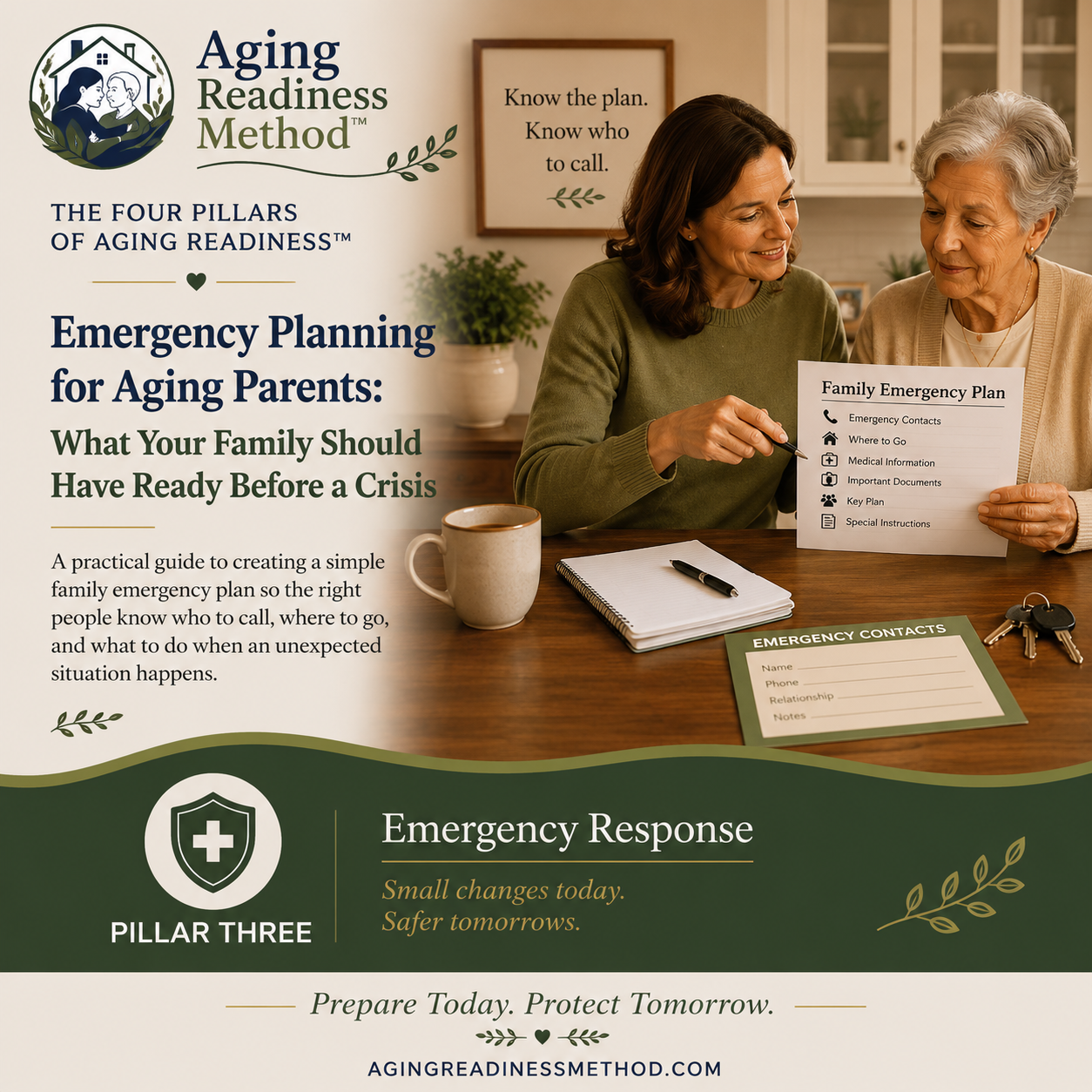
A practical guide to creating a simple family emergency plan so the right people know who to call, where to go, and what to do when something unexpected happens.
Pillar Three • Emergency Response • 7 Min Read

Most families have some idea of what they would do if an aging parent had an emergency.
Call 911. Contact a sibling. Go to the hospital.
But emergencies rarely unfold as neatly as we imagine.
A parent falls and can’t get to the phone. An ambulance takes them to the hospital while another family member is several hours away. Nobody remembers the neighbor’s number. Someone needs to care for the dog. The emergency room asks for a medication list. One sibling assumes another has already been contacted.
Suddenly, a family that normally communicates well is trying to make important decisions while information is incomplete and emotions are running high.
A family emergency plan doesn’t need to anticipate every possibility.
It simply needs to answer a few important questions before everyone is under pressure.
Start With One Simple Question
Ask your family:
“If something happened to Mom or Dad tonight, what would each of us do?”
Don’t worry about creating a perfect plan yet.
Walk through the first few hours.
Who would probably learn about the emergency first?
Who lives close enough to respond?
Who should be contacted?
Who could get into the home if necessary?
Who would go to the hospital?
Who could take care of things at home?
You may discover that everyone has been operating under slightly different assumptions.
That’s exactly why having the conversation matters.
1. Know When to Call 911
Families sometimes hesitate during an emergency because they aren’t sure whether a situation is serious enough to call for help.
For potentially life-threatening emergencies, calling 911 should not be delayed while trying to reach other family members first.
Your family’s plan should make one principle clear:
Emergency response comes before the family phone tree.
Once appropriate emergency help is underway, the family communication plan can begin.
2. Decide Who Should Be Contacted First
Create a short list of the people who should be contacted during an emergency.
That may include:
- Adult children or other close family members
- A nearby relative
- Trusted neighbors
- Caregivers
- Physicians or other appropriate healthcare contacts
- Someone who can help with pets or the home
Avoid creating an enormous list.
The purpose is to identify the few people who need to know first.
It can also help to designate one family member to update everyone else. That reduces duplicate phone calls and conflicting information when several people are trying to help at once.
3. Make Sure Someone Can Access the Home
Imagine an ambulance has taken your parent to the hospital and the front door is locked.
Could someone in the family get inside?
There may be medications, identification, insurance information, a phone charger, clothing, or other items that need to be retrieved.
Your family should determine in advance how a trusted person could access the home.
Depending on the household, that might involve:
- A trusted family member with a spare key
- A trusted neighbor
- A secure lockbox
- An electronic entry system
- Another agreed-upon method
The important part isn’t which method you choose.
It’s making sure the answer isn’t:
“I think someone has a key.”
4. Know Where Essential Information Is Located
An emergency plan and an important-document plan work together.
Family members responding to an emergency should know how to locate basic information such as:
- Current medications
- Allergies
- Health insurance information
- Emergency contacts
- Primary physician
- Healthcare power of attorney or other relevant healthcare documents
- Preferred hospital, when applicable
You don’t necessarily need to carry copies of everything.
You do need a reliable way to find important information quickly.
5. Plan for the Things Left Behind
When someone is unexpectedly taken to the hospital, everyday responsibilities don’t disappear.
Someone may need to:
Feed a pet.
Lock the house.
Cancel an appointment.
Pick up the mail.
Move a vehicle.
Turn off an appliance.
Contact a caregiver.
Bring necessary personal items to the hospital.
These tasks aren’t the emergency itself, but they can quickly become additional problems if nobody knows who is handling them.
A good emergency plan identifies one or two nearby people who can take care of the home while others focus on the person.
6. Consider What Happens When the Primary Family Contact Is Away
Many family emergency plans depend heavily on one person.
Often it’s the adult child who lives closest to the parent.
But what happens if that person is traveling, sick, unreachable, or dealing with an emergency of their own?
Every plan should have a backup.
Ask:
Who is our second call?
A simple backup can prevent the entire response plan from depending on one person’s availability.
7. Make the Plan Easy to Find
An emergency plan isn’t very useful if it’s buried in someone’s email or saved on a computer nobody else can access.
Keep the basic plan somewhere appropriate and accessible to the people who may need it.
It might include:
Emergency contact: Name / phone
Backup contact: Name / phone
Nearby trusted person: Name / phone
Preferred hospital: Name
Medication information: Location
Important documents: Location
Home access: Agreed method
Pet plan: Person responsible
Keep it simple.
This isn’t meant to become another complicated family binder nobody uses.
It is a roadmap for the first few hours of an unexpected event.
8. Walk Through the Plan Once
You don’t need to conduct a formal emergency drill.
Instead, spend ten minutes talking through a realistic scenario.
For example:
“Mom falls at home at 8:00 on a Tuesday evening and an ambulance takes her to the hospital. What happens next?”
Then walk through it.
Who gets called?
Who goes to the hospital?
Who gets into the house?
Who finds the medication information?
Who takes care of the dog?
Who contacts the rest of the family?
You’ll probably discover one or two gaps almost immediately.
That’s valuable.
Finding the gaps now is much easier than finding them during the emergency.
A Small Step You Can Take Today
You don’t need to build your family’s entire emergency plan today.
Start with five things:
1. Choose the primary family contact.
2. Choose a backup contact.
3. Identify someone who can access the home.
4. Confirm where essential medical information can be found.
5. Decide who handles pets or household needs.
Write those answers down and make sure the appropriate people know the plan.
That’s a meaningful start.
Prepared Doesn’t Mean Expecting the Worst
Talking about emergencies can feel uncomfortable because nobody wants to imagine something happening to someone they love.
But planning isn’t predicting that something bad will happen.
It’s making sure that if something does happen, the people who care about one another aren’t trying to invent a response in the middle of it.
A little preparation can replace confusion with direction.
And during an emergency, knowing what to do next can make an enormous difference.
Continue Building Your Family’s Aging Readiness Plan
Emergency Response is Pillar Three of the Aging Readiness Method™.
Together, the Four Pillars help families prepare across:
Home Safety Preparedness • Important Document Identification • Emergency Response • Family Communication
Prepare Today. Protect Tomorrow.