


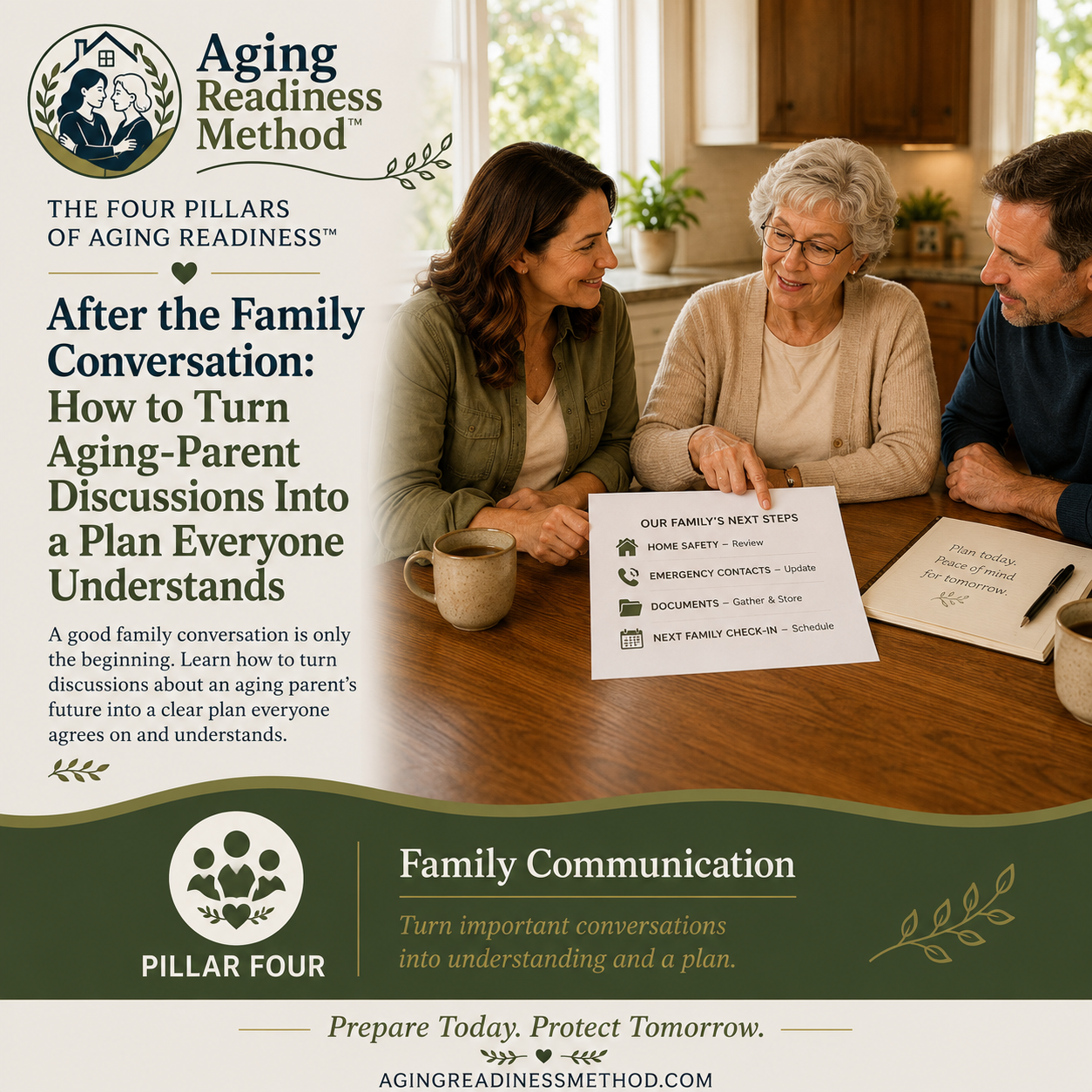
After the Family Conversation: How to Turn Aging-Parent Discussions Into a Plan Everyone Understands
A good family conversation is only the beginning. Learn how to turn discussions about an aging parent’s future into clear responsibilities, shared expectations and practical next steps.
Pillar Four • Family Communication • 7 min read

The family finally had the conversation.
Mom talked about wanting to remain in her home.
Your brother agreed to help with appointments.
You offered to organize some of the important information.
Everyone discussed what might happen if Mom eventually needed more help.
It felt productive.
Then three months passed.
Your brother thought you were handling the medical information.
You thought he was.
Mom remembers agreeing to organize some paperwork but doesn’t remember which paperwork.
Your sister thought everyone agreed that Mom would eventually move closer to her.
Mom doesn’t remember agreeing to move anywhere.
Nobody did anything wrong.
The family talked.
They just never turned the conversation into a shared understanding of what happens next.
That’s an important distinction.
Family communication isn’t complete simply because difficult subjects have been discussed.
A useful conversation should eventually answer:
What did we learn?
What did we decide?
What still needs to be decided?
Who is doing what next?
And most importantly:
Does Mom or Dad understand the plan the same way everyone else does?
That’s where conversation begins becoming readiness.
1. Don’t Try to Solve Everything in One Conversation
Once families finally begin talking about aging, there’s a temptation to cover everything.
Housing.
Finances.
Healthcare.
Driving.
Legal documents.
Home safety.
Emergency planning.
Caregiving.
Funeral arrangements.
That’s a lot.
And trying to resolve every issue at once can turn an important family conversation into an exhausting meeting.
Instead, think in stages.
One conversation might simply establish:
Mom wants to remain at home as long as reasonably possible.
That’s valuable information.
The next conversation might explore:
What would help make that possible?
Then:
What should we work on first?
Readiness develops over time.
The objective isn’t to complete the family’s entire aging plan over Sunday dinner.
It’s to keep moving important decisions forward while there’s still time to make them thoughtfully.
2. Separate Wishes From Decisions
This distinction can prevent misunderstandings.
Suppose Dad says:
“I’d really rather never leave this house.”
That’s important.
But it doesn’t necessarily mean the family has decided:
Dad will remain in this house under every possible circumstance.
His statement expresses a preference.
The family can acknowledge it without pretending every future circumstance is predictable.
A useful response might be:
“We understand staying here is really important to you. Let’s look at what we can do now to make the home safer and help support that goal.”
Now Dad’s preference has become useful planning information.
Families don’t have to promise an unknowable future in order to respect someone’s wishes today.
3. End Important Conversations With a Simple Recap
Before everyone moves on, take two minutes.
Ask:
“Before we finish, can we make sure we’re all understanding this the same way?”
Then summarize.
For example:
“Mom wants to stay in the house.”
“We’re going to start by looking at home safety.”
“I’ll help Mom identify the important documents.”
“David is going to update the emergency contacts.”
“We’re not making any decisions about moving right now.”
That last statement can be just as important as the others.
A recap prevents family members from filling in the blanks later with their own assumptions.
4. Write Down the Next Steps
This doesn’t need to become meeting minutes.
A simple list is enough.
Family Readiness — Next Steps
Mom: Find the insurance information.
Susan: Schedule a time to walk through the house with Mom.
David: Confirm emergency contacts.
Everyone: Talk again next month about healthcare information.
That’s it.
Four lines can transform:
“We should really do something about this.”
into:
“Here’s what we’re doing next.”
Written next steps also reduce the burden on Mom or Dad to remember every detail of a complicated family discussion.
5. Assign Tasks—Not Control
There’s an important difference between helping and taking over.
Instead of:
“I’ll take care of your finances.”
try:
“Would it help if I sat with you while we identify where the important financial information is kept?”
Instead of:
“We’re going through your house and getting rid of these rugs.”
try:
“Can we walk through the house together and look for anything that might make getting around harder?”
Instead of:
“Give me all your passwords.”
ask:
“How would you like the appropriate person to access important information if you ever needed help?”
The language matters.
ARM isn’t about adult children quietly assuming authority because a parent is getting older.
It’s about families preparing with the person being supported.
6. Match Responsibilities to People’s Strengths
Every family has different capabilities.
One sibling may live nearby.
Another may live 500 miles away but be highly organized.
Someone may be comfortable discussing medical information.
Someone else may understand insurance or finances.
Another family member may be the person Mom trusts most for difficult conversations.
Don’t automatically divide responsibilities equally.
Divide them sensibly.
A long-distance adult child might maintain the family contact information.
The nearby sibling might help with home-safety projects.
Another trusted person might accompany Mom to an important appointment when she requests help.
The objective isn’t:
Everyone does exactly the same amount.
It’s:
Important things have an appropriate person responsible for helping with them.
7. Be Specific About What “Helping” Means
This is where many family plans become vague.
Your sister says:
“I’ll help Mom with medical stuff.”
What does that mean?
Schedule appointments?
Drive her?
Maintain medication information?
Attend appointments?
Communicate with doctors when appropriately authorized?
Keep siblings informed?
Those are very different responsibilities.
Try to define the next action rather than assigning an enormous category.
Instead of:
“Mike handles emergencies.”
try:
“Mike will confirm that Mom’s emergency contacts are current and that the family knows where her emergency information is kept.”
Specific responsibilities are easier to complete.
They’re also easier to change later.
8. Don’t Assign Someone Who Isn’t in the Conversation
Families do this surprisingly often.
“If anything happens, Jennifer can handle that.”
Has anyone asked Jennifer?
Before placing an important responsibility on someone, make sure that person knows about it and is willing and reasonably able to help.
This is particularly important when the responsibility involves:
Healthcare.
Finances.
Legal authority.
Emergency response.
Caregiving.
Pets.
Transportation.
Home maintenance.
Good family planning shouldn’t depend on someone discovering their assigned role during the crisis.
9. Clarify Who Needs to Know What
Not every family member needs every detail.
That’s particularly true with personal medical, legal and financial information.
Your parent may be comfortable sharing certain information with one adult child but not another.
Respect that.
The family can still establish a useful communication structure.
For example:
Mom chooses what information is shared.
One person maintains the appropriate emergency information.
The person designated to assist with financial matters knows where relevant documents can be found.
Other siblings receive general updates when appropriate.
Family preparedness doesn’t eliminate privacy.
It should help families determine who appropriately needs access to what information.
10. Decide How the Family Will Communicate During an Emergency
An emergency is a terrible time to establish the family communication system.
Imagine Mom is taken to the hospital.
Three siblings begin calling the hospital independently.
One calls Mom repeatedly.
Another starts texting extended family.
Someone posts an update on social media.
Different versions of the story begin circulating.
Instead, discuss beforehand:
Who will communicate with the hospital when appropriate?
Who will update the immediate family?
How will those updates be shared?
A family group text, phone tree or designated family contact may work well depending on the family.
The tool matters less than having an understood process.
One accurate update can be better than six incomplete ones.
11. Recognize That Siblings May See the Situation Differently
One adult child visits every week.
Another visits twice a year.
Their perceptions of Mom’s situation may be completely different.
One sees:
“Mom is doing great.”
The other sees:
“Mom is struggling.”
Both may sincerely believe they’re right.
Instead of arguing over conclusions, talk about observations.
Rather than:
“Mom can’t live alone anymore.”
say:
“I’ve noticed Mom has stopped using the upstairs bathroom because she’s uncomfortable on the stairs.”
Instead of:
“Dad is becoming forgetful.”
say:
“Dad missed two appointments this month and called me twice because he couldn’t remember when they were scheduled.”
Specific observations create better conversations than broad labels.
They give the family something concrete to discuss.
12. Don’t Let the Most Forceful Person Automatically Become the Decision-Maker
Families have personalities.
Someone talks more.
Someone worries more.
Someone avoids conflict.
Someone wants decisions immediately.
Someone needs time.
A productive family conversation should make room for the person whose future is actually being discussed.
Ask Mom directly:
“What do you think?”
“Does this feel reasonable to you?”
“Is there anything we’re discussing that you’re uncomfortable with?”
“What would you like us to do next?”
Then listen.
Efficiency isn’t the only goal.
A plan everyone understands and can support is usually more valuable than a faster plan imposed by the loudest voice in the room.
13. Record What Hasn’t Been Decided
This is one of the simplest ways to prevent family confusion.
Suppose the family discusses whether Dad might eventually move closer to one of his children.
No decision is made.
Write:
Future housing: Discussed. No decision made.
That’s useful.
It prevents someone from later remembering:
“We already decided Dad would move.”
You didn’t.
You discussed it.
Some topics require several conversations.
A readiness plan can acknowledge uncertainty.
In fact, clearly recording what remains undecided can be just as valuable as documenting what has been decided.
14. Set a Time to Revisit the Conversation
Don’t end with:
“We’ll talk about this again sometime.”
“Sometime” has a habit of becoming never.
Instead:
“Let’s revisit this after Mom’s appointment next month.”
or:
“Let’s check back in after we’ve completed the home-safety review.”
or simply:
“Let’s talk about this again in October.”
Not every family needs formal meetings.
But giving the next conversation a trigger or timeframe keeps preparedness moving forward without making every interaction about aging.
Try the Five-Minute Family Recap
Here’s a simple ARM exercise.
At the end of your next important family conversation, ask five questions:
1. What did we learn today?
2. What did Mom or Dad tell us is important to them?
3. Did we actually make any decisions?
4. What is each person’s next step?
5. When should we talk about this again?
Write down the answers.
Keep them brief.
You may end up with something as simple as:
Mom’s priority: Remain at home.
Decision: Start with home safety and emergency planning.
Susan: Schedule home-safety walkthrough.
Mark: Update emergency contact information.
Still undecided: Future housing options.
Next conversation: After Mom’s October appointment.
That’s a plan.
Not a complete aging plan.
Not every answer the family will ever need.
But a clear next step everyone understands.
The Goal Isn’t Agreement on Everything
Families aren’t always going to agree.
Siblings may have different opinions.
Parents and adult children may assess risk differently.
Someone may want to move faster.
Someone may want to wait.
Aging readiness doesn’t require unanimous agreement about every possible future decision.
It requires something more practical:
Understanding what matters to the person being supported.
Knowing what has actually been decided.
Identifying what still needs attention.
Knowing who is responsible for the next step.
Keeping communication open as circumstances change.
That’s how a conversation becomes something more than a conversation.
It becomes a family readiness process.
And when circumstances eventually change, the family doesn’t have to begin with:
“What do we do?”
They can begin with:
“Here’s what we already know.”
That’s a much stronger place to start.
Prepare Today. Protect Tomorrow.