


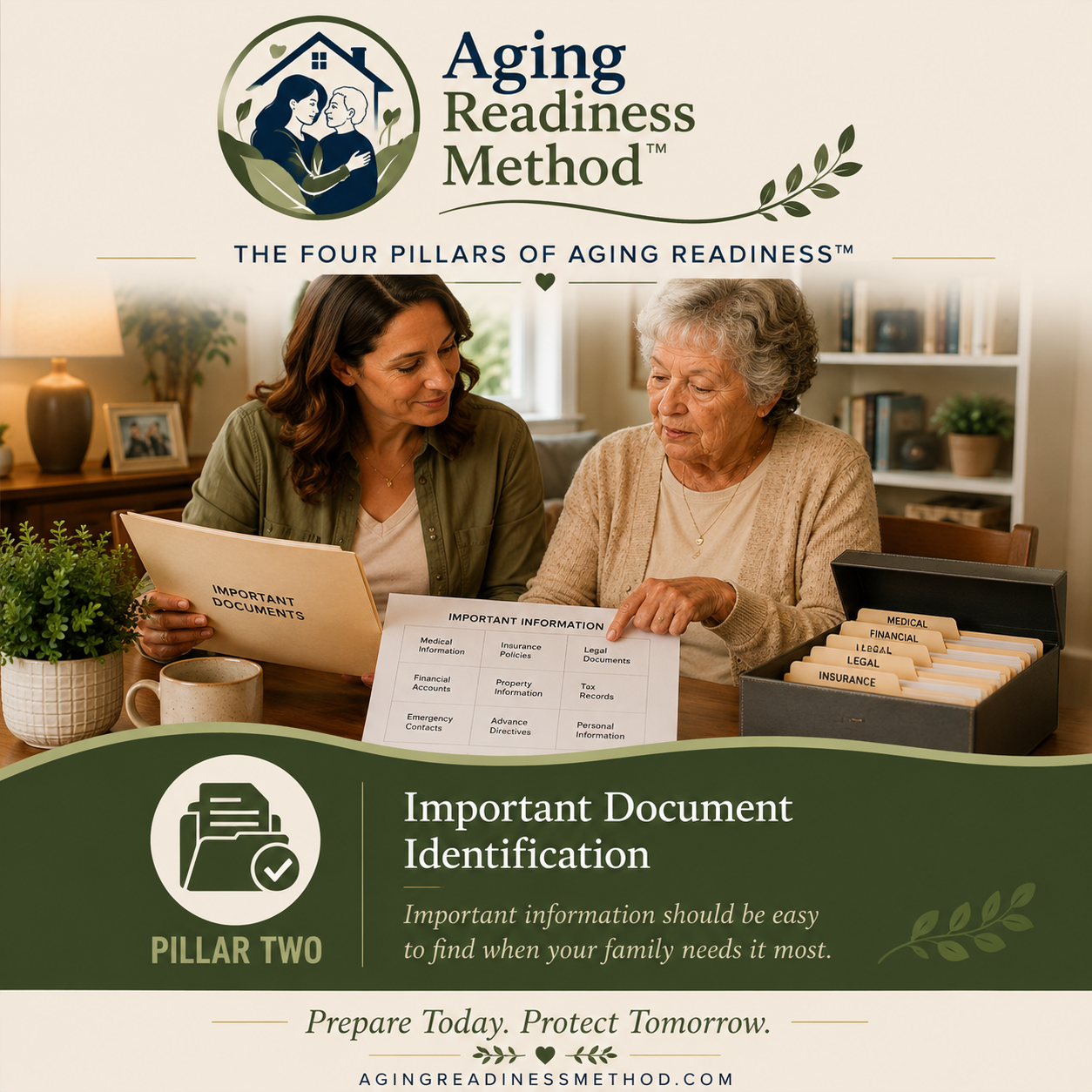
Where Are the Important Originals? Identifying and Protecting Documents That Can’t Be Easily Replaced
Some papers can be duplicated. Others are difficult to replace. Learn which original documents may matter most, where they may be kept and how families can make sure they can be found when needed.
Pillar Two • Important Document Identification • 7 min read

Your family has made progress.
You know Mom has a will.
Dad has a life insurance policy.
You’ve identified the bank accounts.
Someone knows which attorney prepared the estate documents.
Important information is becoming organized.
But there’s another question worth asking:
Where are the originals?
Not the photocopy.
Not the PDF someone emailed five years ago.
Not the document you think might be somewhere in the filing cabinet.
The actual original.
For some documents, a copy may be perfectly adequate for everyday reference. For others, an original or certified copy may become important depending on the situation.
And when a family is already dealing with a hospitalization, death, property transaction or other major event, discovering that nobody knows where an important document is located creates one more problem at exactly the wrong time.
Pillar Two isn’t about collecting every piece of paper your parents have ever accumulated.
It’s about making important information identifiable and findable.
And sometimes that means knowing where the original lives.
1. Start With a Different Question
Families often begin document planning by asking:
“Do you have a will?”
That’s a good question.
But it isn’t quite enough.
Follow it with:
“Where is the original?”
Then:
“If we needed it and you weren’t available, would the appropriate person know how to get it?”
Those questions reveal the difference between a document existing and a document being accessible when needed.
Mom may know exactly where everything is.
That works while Mom is available to answer.
A readiness plan anticipates the possibility that someday she may not be.
2. Identify the Important Personal Records
Start with basic identity and family records.
Depending on your parent’s circumstances, these might include:
- Birth certificate
- Marriage certificate
- Divorce decree
- Adoption records
- Social Security card
- Passport
- Citizenship or naturalization records
- Military discharge records
- Veteran-related documents
Not every family will have every document.
That’s fine.
The objective isn’t to complete a universal checklist.
It’s to identify which important records apply to your parent and where they can be found.
For documents that can be replaced with certified copies, it may also be useful to understand where those copies would be requested if an original is lost.
3. Locate Estate-Planning Documents
Estate-planning documents deserve particular attention because families frequently know they exist without knowing where the signed documents are located.
These may include:
- Will
- Trust documents
- Financial power of attorney
- Healthcare power of attorney or healthcare proxy
- Advance directive or living will
- Other estate-planning documents
Ask:
Who prepared them?
Where are the signed originals?
Does the appropriate decision-maker know where they are?
Are copies stored elsewhere?
Has anything been updated since the documents were created?
Don’t assume the attorney automatically has everything the family might eventually need.
And don’t assume the copy in a desk drawer is necessarily the current version.
If there’s uncertainty about which legal document is valid or whether an original is required, that is a question for the appropriate attorney—not something the family should guess about.
4. Identify Property Ownership Records
Property can create another category of important paperwork.
Depending on what your parent owns, consider identifying records related to:
- Home ownership
- Other real estate
- Vehicles
- Boats
- Recreational vehicles
- Valuable personal property
Titles and deeds may increasingly be reflected in government or electronic records, and requirements differ by jurisdiction and transaction.
The ARM objective isn’t to tell families which paper document has legal priority.
It’s much simpler:
Know what Mom or Dad owns and know where the relevant ownership information can be found.
That information may eventually save the family hours of searching.
5. Don’t Overlook Insurance Policies
Families may pay insurance premiums for years without ever looking at the underlying policy information.
Identify applicable coverage such as:
- Homeowners or renters insurance
- Automobile insurance
- Life insurance
- Long-term care insurance
- Supplemental insurance
- Other significant policies
For each one, identify:
Which company issued the policy?
What type of coverage is it?
Where is the policy information kept?
Who is the agent or contact, if applicable?
Is there an online account?
The goal isn’t necessarily to maintain stacks of old insurance paperwork.
It’s to make sure the family can identify current coverage and locate the information needed to contact the appropriate company.
6. Ask About the Safe-Deposit Box
Here’s a classic family surprise:
“Dad had a safe-deposit box?”
If your parent uses one, identify it now.
At minimum, determine:
- Which financial institution holds it
- Where the branch is located
- Who is authorized to access it
- Where access information or keys are appropriately kept
- What types of important items are stored there
Don’t put sensitive access details into an unsecured family checklist.
The goal is to document that the box exists and how an authorized person can determine the proper access process.
Access rules can depend on the institution, account arrangements and applicable law.
If the box contains especially important original documents, the family should understand whether those documents will be reasonably accessible when needed.
7. Don’t Create a New Security Problem
Organizing important information is useful.
Creating one unprotected folder containing everything someone would need to steal an identity is not.
Think carefully about what your family’s document inventory contains.
There is a difference between recording:
Birth certificate — fire-resistant home safe
and creating an unsecured digital file containing a scan of the birth certificate, Social Security card, driver’s license, bank information and account credentials.
ARM’s Ask Once → Use Everywhere principle has a useful parallel here:
Identify once. Store appropriately. Know where to find it.
You don’t necessarily need copies of everything everywhere.
Sensitive information should be protected using storage methods appropriate to the information and your family’s circumstances.
8. Decide Where Originals Should Live
There isn’t one storage location that’s right for every document.
Depending on the document and circumstances, families may use:
- A secure home file
- Fire-resistant home safe
- Safe-deposit box
- Attorney’s office
- Financial professional
- Other secure storage
The important questions are:
Is the document protected?
and
Can the appropriate person access it when needed?
A document that is extraordinarily secure but effectively inaccessible may create a different problem.
Likewise, a document that’s easy for everyone to access may not be adequately protected.
Families need an appropriate balance between security and accessibility.
9. Don’t Hide Things Too Well
People sometimes develop very creative hiding places for valuables and important papers.
An envelope under a drawer.
Documents inside an old book.
Cash in the freezer.
A key taped beneath something in the garage.
The problem with a secret hiding place is obvious:
It remains secret when someone else needs to find it.
You don’t need to advertise where valuables are stored.
But at least one appropriate, trusted person should understand how important records can be located if necessary.
Otherwise, a clever hiding place can eventually become a permanent hiding place.
10. Create an Important Originals Inventory
You don’t have to move Mom’s documents.
You don’t even have to copy them.
Instead, create a simple inventory.
For example:
Will
Original location: Home safe
Prepared by: Smith & Jones Law
Last updated: 2024
Vehicle title
Location: Home file cabinet
Vehicle: 2023 Honda CR-V
Life insurance policy
Company: Example Life
Policy information: Home insurance file
Contact information: Recorded in family plan
Birth certificate
Location: Safe-deposit box
Notice what this inventory does not need to contain.
Bank passwords.
Safe combinations.
Full Social Security numbers.
Every piece of sensitive information.
The inventory answers the readiness question:
What exists, and where should the appropriate person look?
That’s enormously useful by itself.
11. Distinguish Originals From Working Copies
One simple organizational improvement is to separate the original from the working copy.
Suppose Mom’s original healthcare power of attorney is stored securely.
A copy may be kept somewhere more convenient for appropriate reference.
The family inventory can then identify both:
Original: secure storage location
Copy: family planning file
This reduces the temptation to repeatedly handle or move an important original just because someone needs to review the information.
For legal, financial or medical use, confirm with the appropriate organization or professional what form of the document is required.
12. Make Sure the Right Person Knows
A beautifully organized filing system doesn’t help much if only one person understands it.
Consider who may reasonably need to know how to locate important information.
That might include:
A spouse.
The person designated under a power of attorney.
An executor or personal representative.
A trustee.
An adult child helping with preparedness.
Another trusted individual chosen by your parent.
This does not mean giving every family member unrestricted access to every document.
It means making sure the people your parent has chosen aren’t starting from zero when they’re called upon to help.
13. Review the Inventory After Major Changes
Important documents don’t remain static forever.
People:
Move.
Buy or sell property.
Change vehicles.
Update estate plans.
Change insurance companies.
Open or close accounts.
Lose spouses.
Remarry.
Change designated decision-makers.
Your document inventory should therefore be a living reference, not a one-time project.
Review it periodically and after major life changes.
Ask:
Does this still exist?
Is this still the current document?
Is it still stored where our inventory says it is?
Does the appropriate person still know how to find it?
A five-minute review can keep years of organization from gradually becoming outdated.
Try the 15-Minute Original Document Test
Here’s a simple ARM exercise.
Choose five important documents that apply to your parent.
For example:
Will
Healthcare power of attorney
Birth certificate
Vehicle title
Life insurance policy
Now ask:
Where is the original or authoritative record?
Could you locate it within 15 minutes?
Is it the current version?
Does the appropriate person know where it is?
Is it stored securely?
You don’t even have to retrieve the documents.
You’re testing whether the family knows where they are.
If the answer is:
“Mom knows.”
That’s a starting point.
Ask Mom.
Then record the answer appropriately.
Findable Is Part of Prepared
Families sometimes imagine preparedness as having one enormous binder containing every important document.
It doesn’t have to work that way.
Mom’s will can stay in the secure location she chose.
Dad’s vehicle title can stay where he keeps it.
Insurance records can remain with the insurance information.
The family doesn’t need to reorganize someone’s entire life.
It needs a map.
What exists?
Where is it?
Who should know?
How can the appropriate person access it?
And is that information still current?
Those questions turn a collection of scattered documents into something far more valuable:
A family that knows where to start.
That’s what Pillar Two — Important Document Identification is really about.
Not collecting paperwork for the sake of collecting paperwork.
Making important information findable before circumstances make finding it urgent.
Prepare Today. Protect Tomorrow.